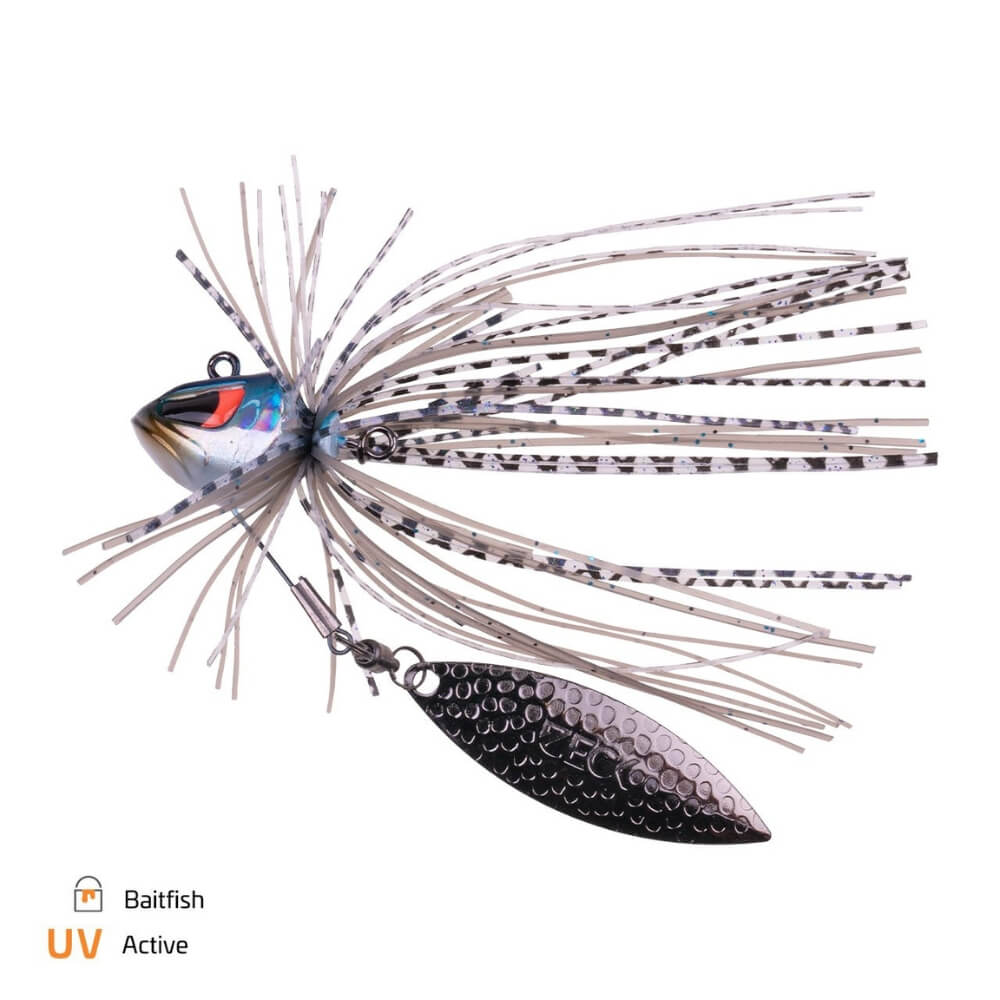
<h2>Buying Guide: Spinnerbaits</h2><p>While the classic <strong>spinner</strong> is one of the best-known lures and is widely used as an all-round option, its American counterpart is still comparatively unknown outside the US and has yet to find its way into every tackle box. In the States, however, spinnerbaits are an absolute standard - used in freshwater for <strong>largemouth bass</strong>, <strong>pike</strong> and other predators. Compared with the classic spinner, their construction gives them a number of advantages that make them highly effective in many situations.</p><h2>Anatomy of a Spinnerbait</h2><p><img src="https://cdn.shopify.com/s/files/1/0548/9197/0669/files/River2Sea-Bling-Spinnerbait.jpg" alt="Spinnerbait" width="200" height="200">A spinnerbait consists of at least one <strong>spinner blade</strong> (2) mounted on a <strong>ball-bearing swivel</strong> (1), a <strong>hook with a lead head</strong> (3) that is usually fitted with a <strong>skirt</strong> (rubber fringe, 4), and a <strong>V-shaped wire frame</strong> (5) connecting hook and blade. In most cases there is a second blade (6) mounted below the upper one on the wire shaft, and on some models even more. This lower blade is mounted on a fork and held in position by beads.</p><p>The angled wire frame creates two axes. One carries the rotating blades that send out pressure waves, while the other, horizontal axis holds the weight and the free hook. This design allows you to fish the lure through weed and other snag-prone areas, as the wire arm shields the hook from obstructions.</p><p>A further advantage: the jig-style hook can be combined with a <strong>soft lure</strong> to add a visual or hydrodynamic trigger. A soft lure with a pin tail or V-tail works well here, though action soft plastics with a paddle tail or a curly tail grub are also suitable.</p><p>Blade variants</p><p>As with the classic spinner, spinnerbaits are available with different blade shapes. In fact the range is even more varied - there are five more or less distinct variants on the market:</p><ul><li><strong>Colorado blade (a):</strong> The wide Colorado, with its spoon-like, almost round profile, generates extremely strong pressure waves and starts rotating even at the slowest retrieve, making it particularly well suited to still waters.<br><br><img src="https://cdn.shopify.com/s/files/1/0548/9197/0669/files/SG-Dabush_Spinnerbaitscd5Am09XoBDK.jpg" alt="Colorado Blade" width="200" height="200"></li><li><strong>Indiana blade (b):</strong> This blade is teardrop-shaped and narrower than the Colorado, so you can retrieve it faster and use it in light current. It also offers less air resistance on the cast, so it flies further. A middle ground is the <strong>Oklahoma blade</strong>, which is slightly wider than the Indiana but tapers to a point, putting its characteristics between the two.<br><br></li><li><strong>Willow blade (c):</strong> Willow blades are slim with a surfboard-like profile. They taper to a point at both ends and are especially suited to flowing water, fast retrieves and long casts. Here too there is an intermediate form, the <strong>Royal blade</strong>, which is shaped like a spade and rotates slightly more irregularly.<br><br><img src="https://cdn.shopify.com/s/files/1/0548/9197/0669/files/River2Sea-Bling-Spinnerbait2.jpg" alt="Willow Blade Spinnerbait" width="200" height="200"</li></li></ul><h3>Target Species and Applications</h3><p>Spinnerbaits are primarily used for <strong>pike</strong>, <strong>largemouth bass</strong> and <strong>perch</strong>, but they also catch <strong>zander</strong> and <strong>wels catfish</strong>. They tend to provoke aggressive attacks - it is thought that predators become so irritated by the lure that they strike to drive it away. This means even inactive fish can often be tempted.</p><p>The wide variety of shapes and sizes, combined with the option of adding <strong>soft lures</strong>, gives spinnerbaits a very broad range of applications. In spring you can crank them through shallow weed, in summer work them just above weed beds or along drop-offs. In cold water, a heavy spinnerbait is excellent for jigging to draw sluggish, bottom-hugging predators into action.</p><h3>Retrieve Techniques</h3><p>Spinnerbaits work well on a steady, even retrieve - much like a spinner or crankbait. Retrieve them as slowly as the blade action allows. After casting, a short snap of the rod tip helps get the lure moving. A light stop-and-go adds another dimension: on the pause the skirt pulses and the lure drops slightly - this is the moment most predators strike.</p><p style="text-align: center;"><iframe frameborder="0" src="https://www.youtube.com/embed/BQN1w7fJNyA?start=343" width="560" height="315" allowfullscreen=""></iframe></p><p>For jigging, let the lure sink on a tight line - the blades are already spinning as it falls. Once it reaches the bottom, twitch it up with the rod and then wind it back down towards the bottom as it sinks. Finally, a note on bite detection: not every take announces itself with the typical jolt. Pike in particular will often simply push up behind a steadily retrieved spinnerbait and engulf it - the only indication you get is that the blade vibration stops. This can also mean debris on the hook, but to be safe: always strike when the vibration disappears.</p>